
World Anvil Alternatives
This post was written by the TypeTak team. Our own product is part of the comparison, so please read with that in mind. That's why we built it on official sources and cited user reviews, and worked to keep it fair to every tool. Prices and features reflect each service's official pages as of October 2026 and may change. We compare from a novelist's point of view and leave out RPG features like statblocks and campaign management.
What is World Anvil?
World Anvil is a tool for building your world up like a wiki. You write characters, places, organizations, species, and magic as articles from templates, and draw the world out with maps, timelines, and family trees. Finished worlds can be published to the web for readers or players, and Manuscripts lets you write the book there too.
World Anvil has chosen not to add AI. When users asked for it, World Anvil declined, saying "AI features are not within the scope of World Anvil."
Why writers use World Anvil
Writers use it to build a world with nothing left out. More than 25 templates guide each entry with prompts about what to write, and maps, timelines, and family trees all sit in one place. There's also a large community sharing published worlds.
"World Anvil is one of the best worldbuilding platforms on the market today."
— Kindlepreneur (2026)
The flip side, many reviews say, is that all those features take time to learn.
"It has a sharp learning curve, which could be a barrier for many authors."
— Kindlepreneur (2026)
Below, we compare four features side by side with TypeTak, Campfire, and LegendKeeper: organizing lore, seeing your world at a glance, writing alongside your world, and publishing and sharing.
1. Organizing lore
| Feature | World Anvil | TypeTak | Campfire | LegendKeeper |
|---|---|---|---|---|
| Organize characters, places, and lore as entries | Articles | World | Modules | Wiki pages |
| Templates by type | 25+ | Define any types you need | 18 modules | Templates |
| Create your own fields | Sidebar fields | Fields per type | Custom Attributes | Properties block |
| Formatting shows as you write | Visual Editor (some formatting only) · BBCode editor with tags | Toolbar · Markdown shortcuts | Word processor | Block editor |
| Link entries to each other | @mentions · Autolinker | [[ links | @mentions · tags | @mentions · auto-linking |
| Backlinks | ||||
| Hide lore from readers | Secrets | Private entries | Hidden panels | Secret blocks |
| AI sets up types and fields for your story | ||||
| Organize lore while writing your novel with AI |
The heart of any worldbuilding tool is stacking up characters, places, and lore as entries and linking them together. All four do this, and all four let you hide lore you're not ready to reveal, like the ending. When you choose, look at the shape your lore takes, and how far you can fit that shape to your own story.
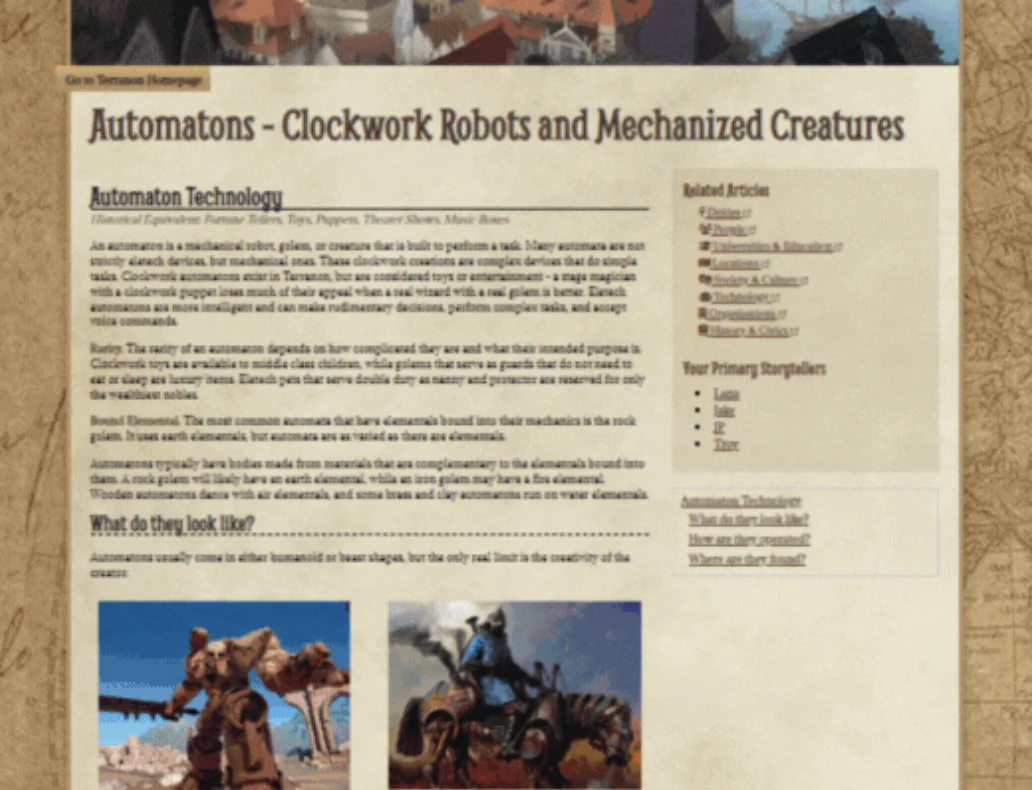
The shape of an entry — World Anvil has the deepest templates. Each of its 25+ templates, from characters and locations to organizations, species, and magic, comes with prompts about what to write, so filling in the blanks pulls out lore you hadn't thought of. Fields follow the shape each template sets.
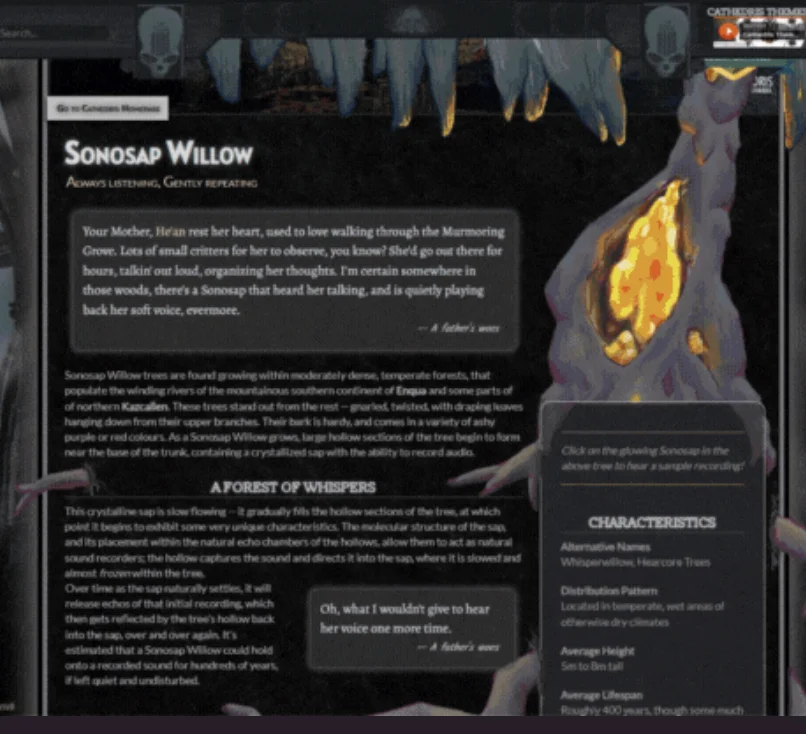
In TypeTak, you define the types your story needs, like characters, places, factions, or magic, and give each type its own fields. You build those types and fields yourself or have the AI set them up to fit your story.
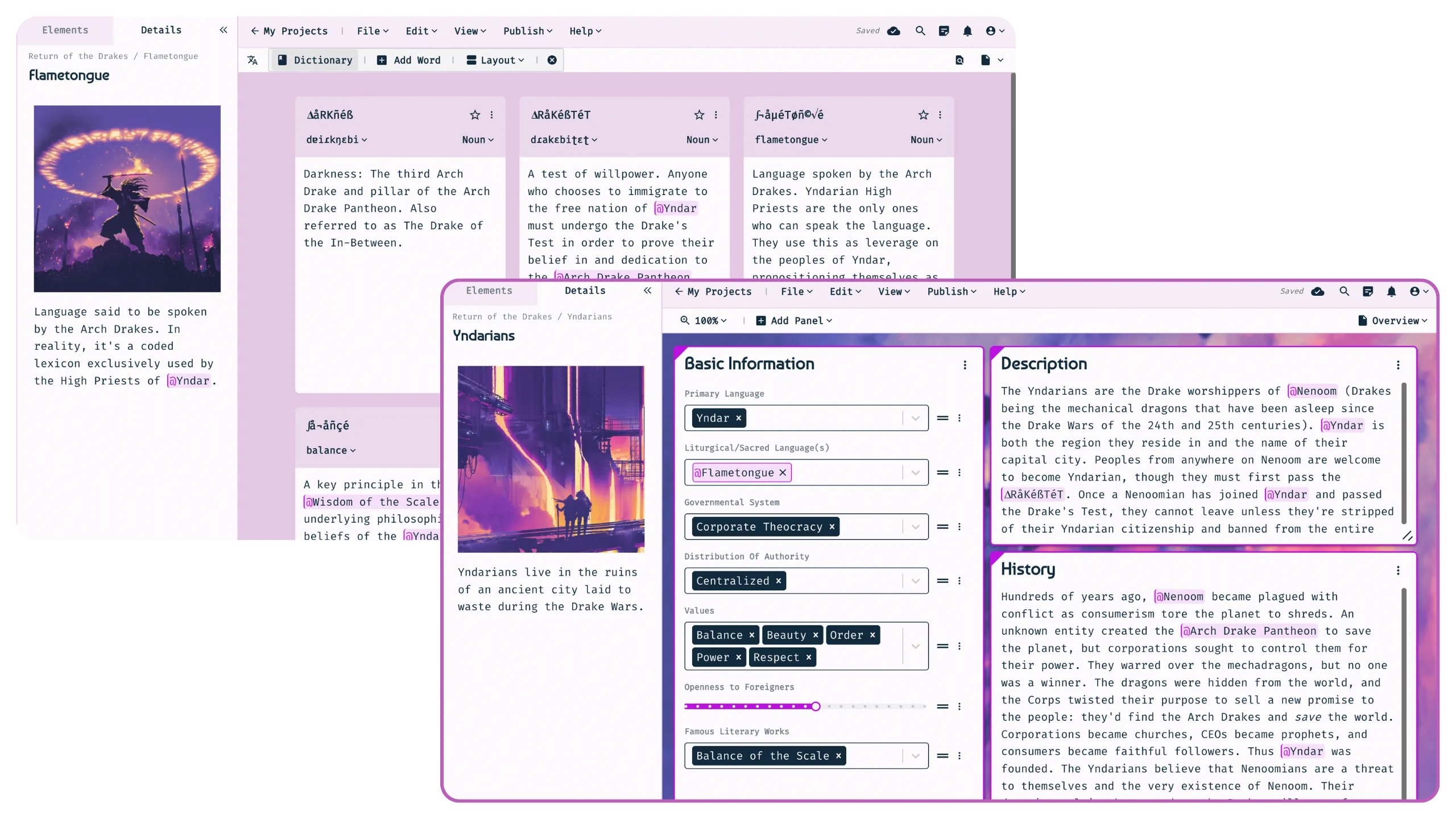
Campfire also gives each kind of lore its own module. There are 18, covering characters, locations, magic systems, languages, religions, and more, and the character module alone has more than 100 attributes. You can also make your own templates and fields (Custom Attributes).
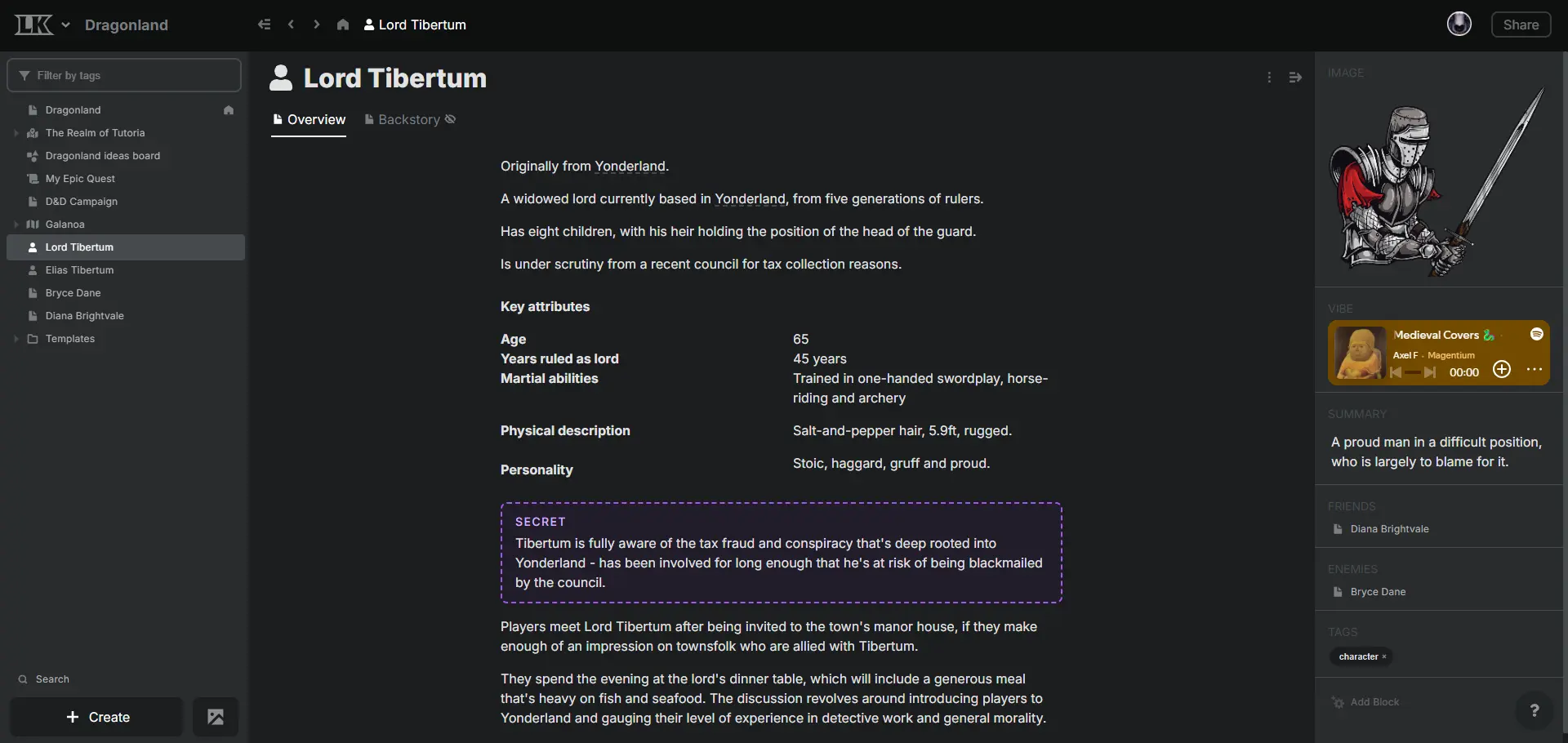
LegendKeeper starts from a blank page with no fixed shape. Slash commands add blocks like images, tables, and an Infobox, and short facts go into a Properties block.
Where you write — The editors differ a lot, too. World Anvil gives you two. The advanced editor takes formatting typed as code (BBCode), like [b] for bold, which gives you plenty of control, and the Visual Editor shows some formatting as you go. TypeTak's editor shows formatting as you write, with a toolbar and Markdown shortcuts. Campfire works like a word processor, and LegendKeeper has you build pages out of blocks.
Linking lore — All four link entries to each other. World Anvil's Autolinker turns words matching article titles into links, and LegendKeeper offers to link names of existing pages as you type. TypeTak and LegendKeeper gather every place that mentions an entry in its backlinks. All four can hide lore, and World Anvil's Secrets let you reveal it only to the readers you choose.
Organizing with AI — Among the four tools, organizing lore with AI is a feature only TypeTak has. In TypeTak, you tick the characters, places, and rules the agent suggests right under its reply, and what you settle while writing collects in the World backlog below the chat box; click Organize to file them into your World. How a character changes in a chapter is written down as Progression entries. You can also build and edit your World entirely by hand.
2. Seeing your world at a glance
| Feature | World Anvil | TypeTak | Campfire | LegendKeeper |
|---|---|---|---|---|
| Interactive maps | Pins · layers · nested maps | Pins · zones · layers | Pins · regions · paths · nested maps | |
| Timelines | Lanes · Chronicles | Built with a board type | Timeline · Gantt | List · Gantt · calendar |
| World calendars | ||||
| Relationship maps | Family trees · diplomacy webs | Relationship graph | Relationship webs · family trees | Drawn on a whiteboard |
| Compare entries of a type in a table | ||||
| Freeform whiteboard | Whiteboards | Canvas | Relationship flowchart · timeline canvas | Boards |
As your lore grows, you start wanting to see the order of events, who's tied to whom, and the lay of the land at a glance. The four tools answer that with timelines, whiteboards, maps, and graphs.
Timelines
All four lay events out in time order and link each event to the lore around it.
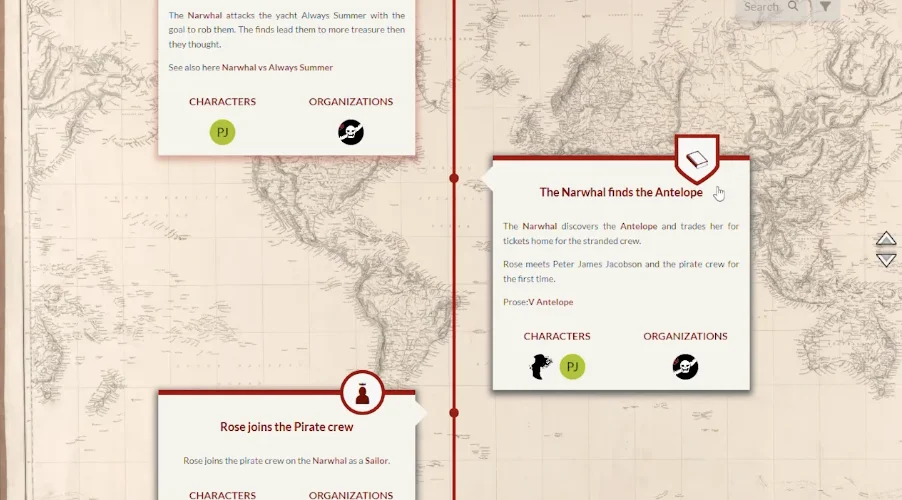
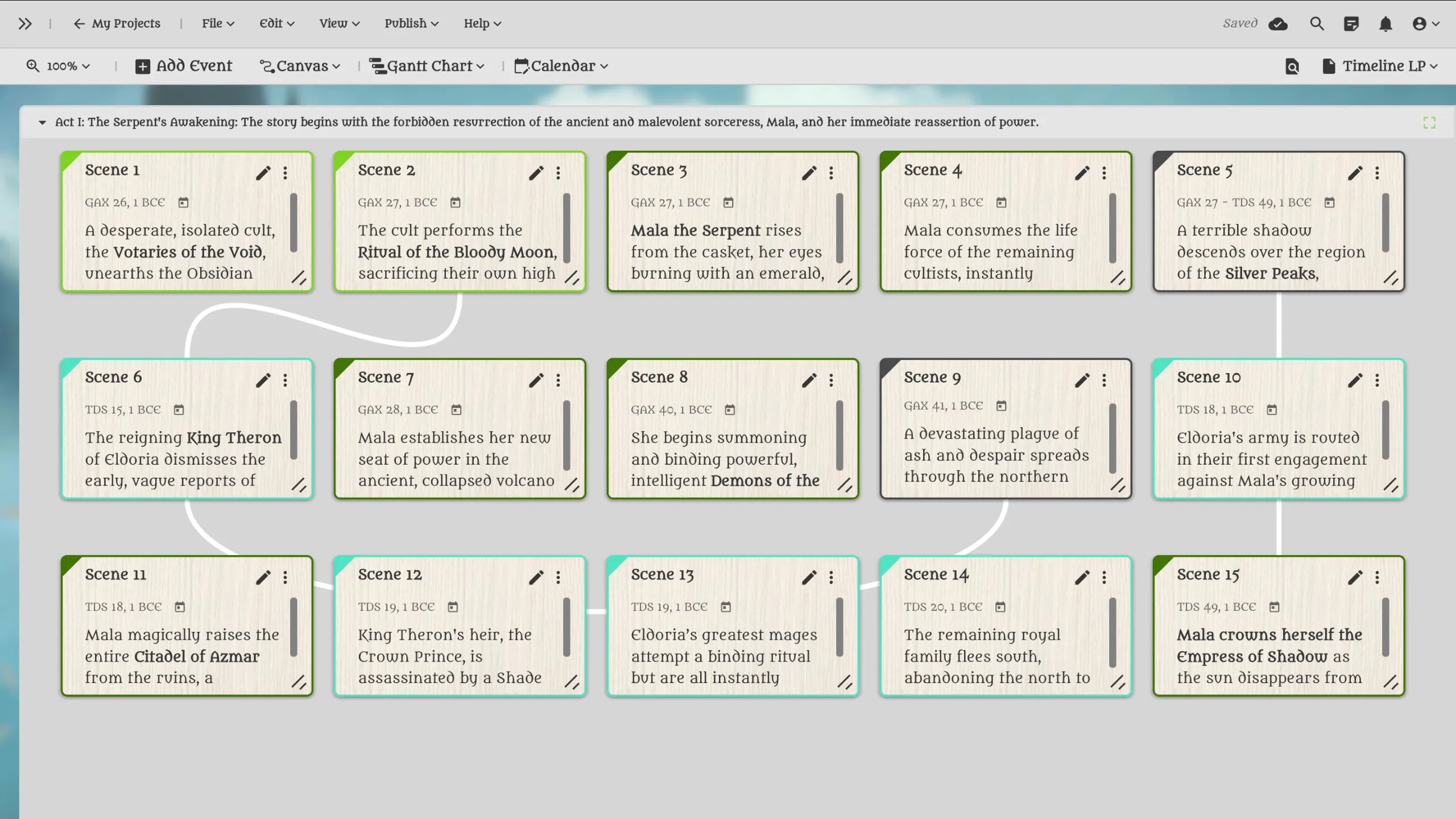
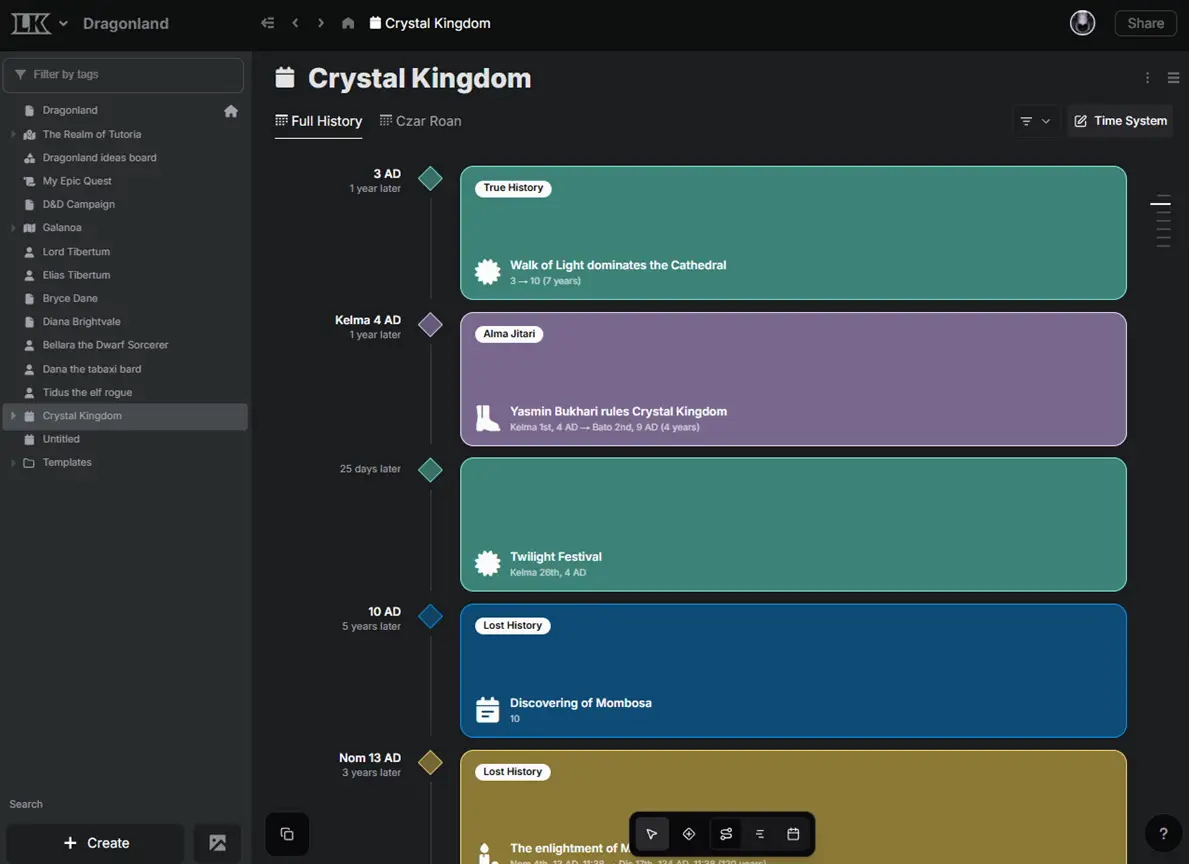
World Anvil runs events in parallel on up to 11 lanes, one per faction or culture, and lays eras such as dynasties beneath them. One event can also appear in several timelines. In TypeTak, a board type made for your chronology becomes a timeline. Event cards carry characters and places from your World, and the same board switches to a table for a row-by-row skim.
Campfire places event cards on rows that can stand for periods or for each character's path. It links cards to show how one event leads into the next, and stays in step with the world calendar. LegendKeeper switches the same events between list, Gantt, and calendar views, and can merge timelines that use different calendars into one.
Whiteboards
All four have a board where you place cards freely and connect them with lines. It's where you sketch out a plot's flow or a web of characters.
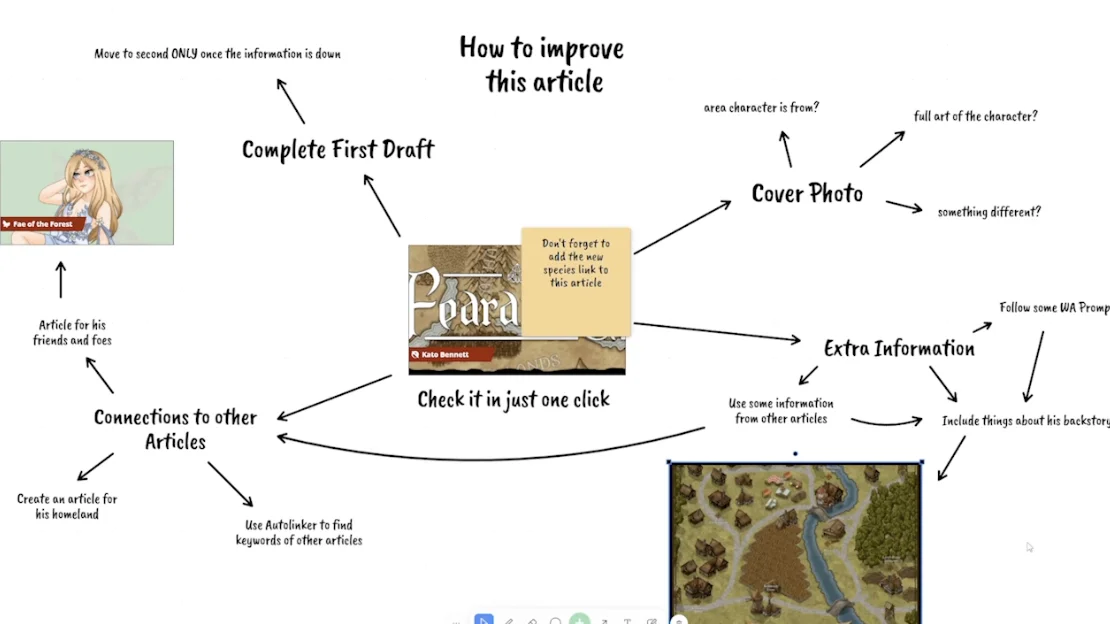
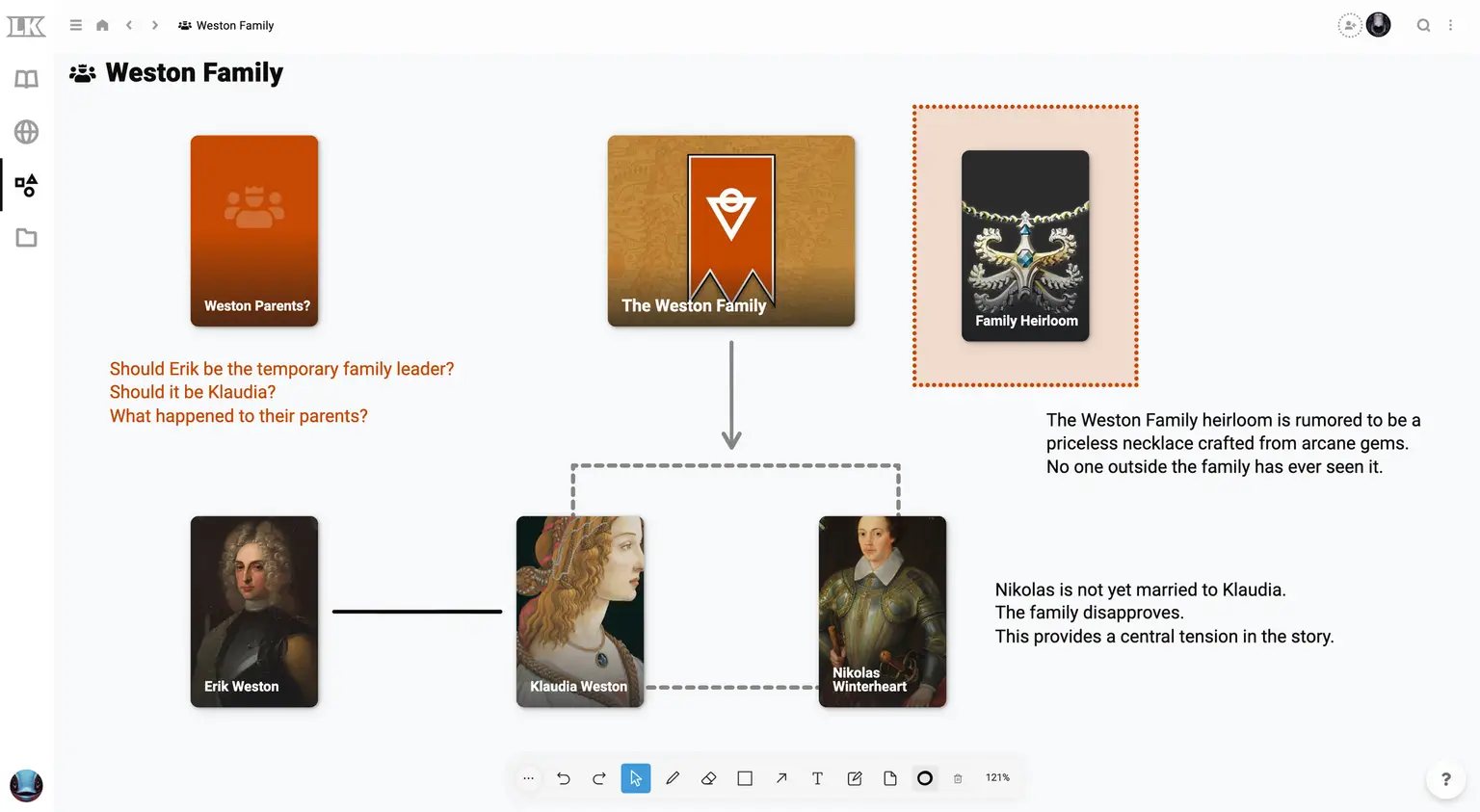
World Anvil's Whiteboards hold shapes, arrows, sticky notes, and freehand drawing alongside articles and maps with their main images, and a finished board can be embedded in an article for readers (Master plan and up). On TypeTak's Canvas, you place characters and places straight from your World, with no retyping, join them with labeled connectors, and group cards into sections by part or place.
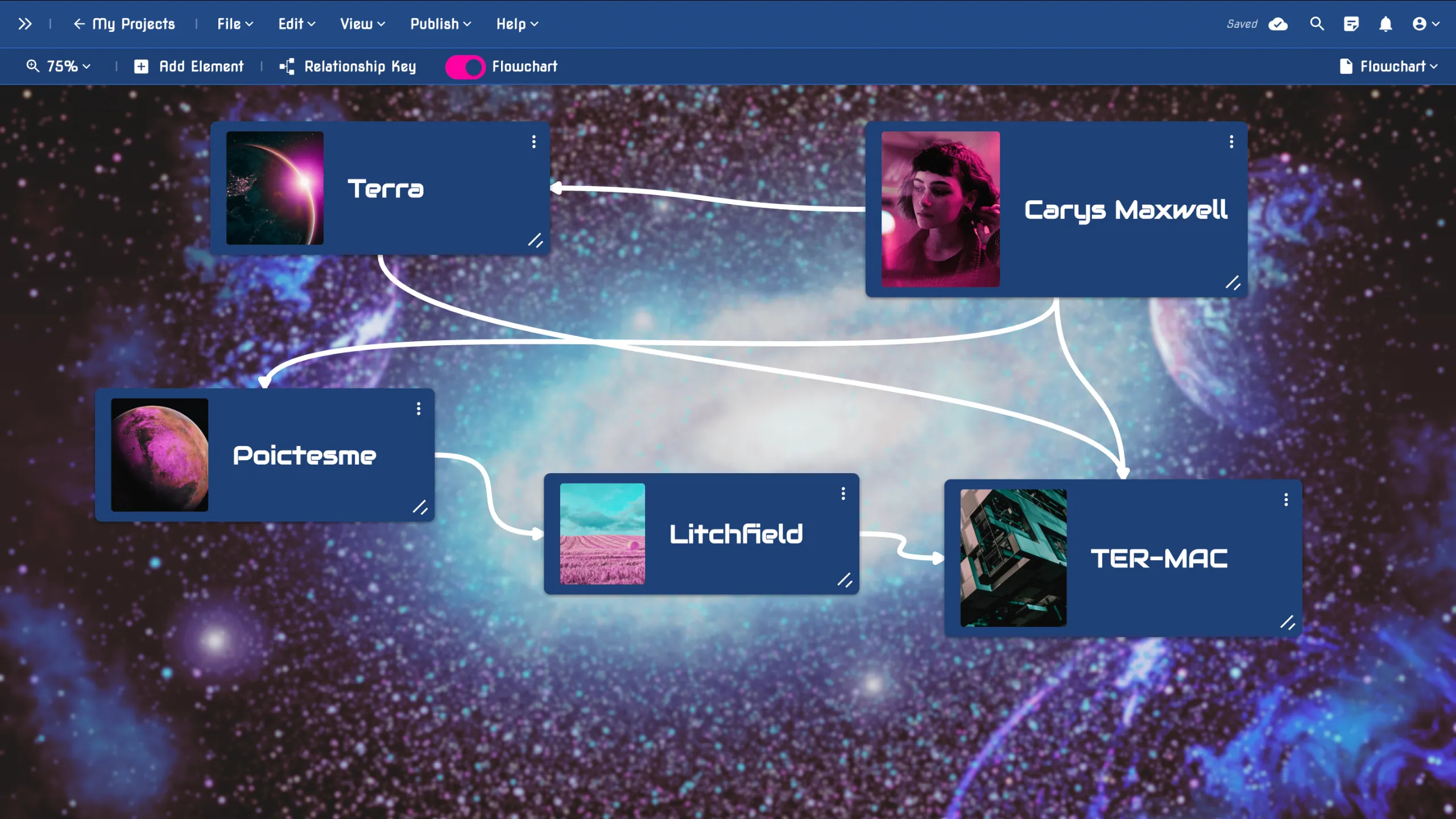
Campfire's relationship web, switched to flowchart mode, puts places and other elements on cards and joins them with arrows. LegendKeeper's Boards are whiteboards you sketch on together with your project members, with wiki pages brought in as cards for family trees, flowcharts, and pointcrawls.
Maps and other views
World Anvil, Campfire, and LegendKeeper all have interactive maps and world calendars. If your story lives and breathes geography, as fantasy often does, these three have you covered.
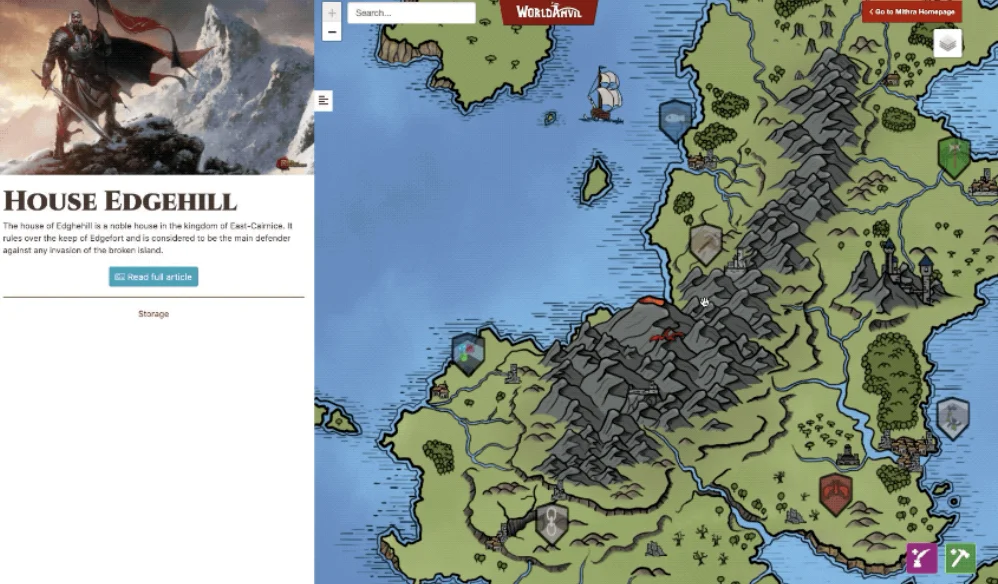
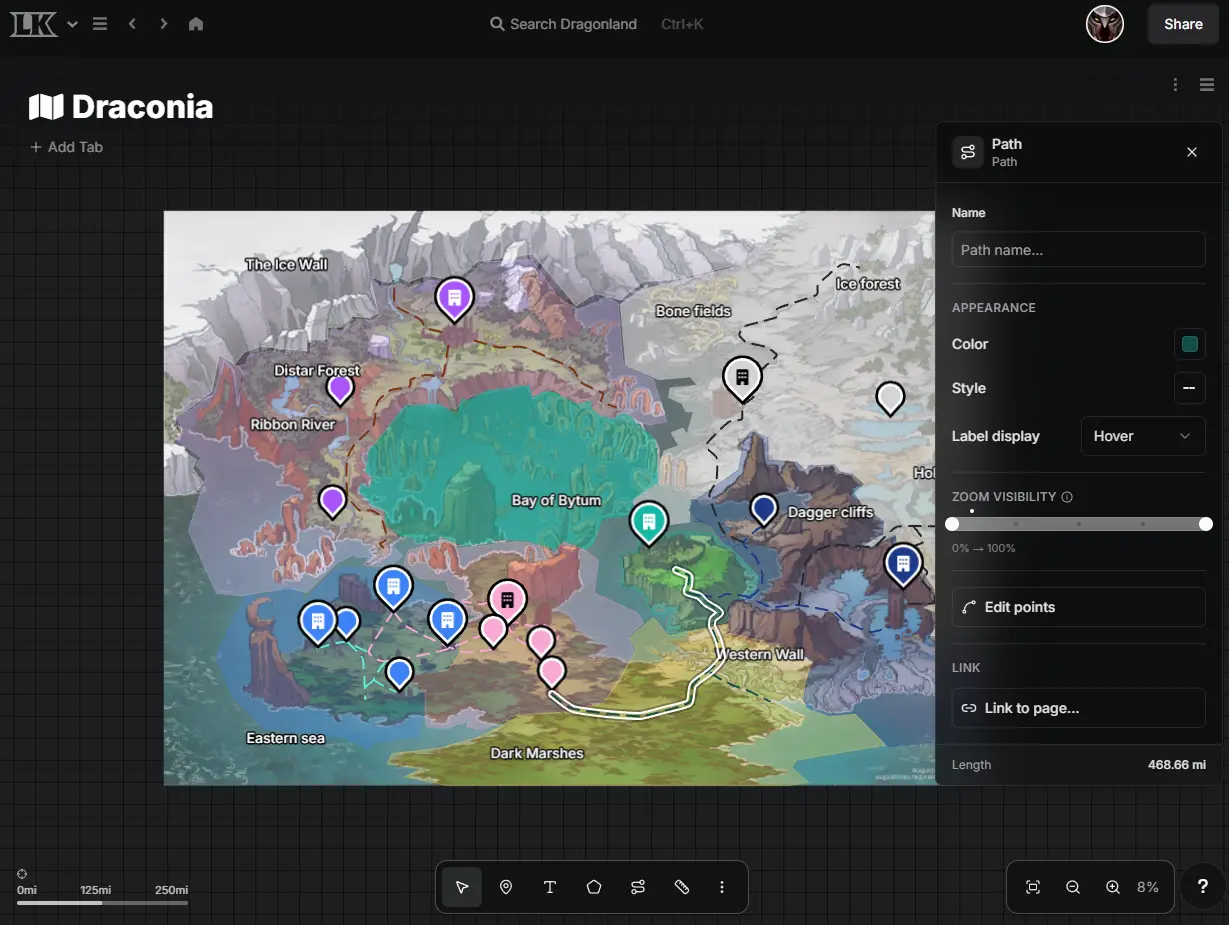
World Anvil puts pins, lines, and polygons on a map and stacks layers; clicking a pin opens its article or steps into another map. Chronicles join a timeline to a map, so clicking an event moves the map to where it happened (Master plan and up). LegendKeeper is built around its maps: it measures distances once a map is calibrated and nests maps inside maps without limit. Campfire maps take icon pins, zones, and layers, plus a ruler and legend.
TypeTak shows the lore in your World entries' fields as a relationship graph and a table.
Relationship graph — see who's tied to whom at a glance. World Anvil draws family trees and diplomacy webs between organizations (Master plan and up), Campfire draws relationship webs and family trees, and LegendKeeper maps relationships on Boards. In TypeTak, write a relationship like "father" or "rival" into a character's field and it becomes a line in the graph, and a relationship you record on one side shows up on the other too.
Table — compare entries of a type side by side. All the characters, or all the places, are laid out in one table, with fields like age, occupation, and affiliation lined up for comparison. Change a type's fields and every entry follows, so even deep into a long series, lore that doesn't add up stands out.
3. Writing alongside your world
| Feature | World Anvil | TypeTak | Campfire | LegendKeeper |
|---|---|---|---|---|
| Manuscript editor | Manuscripts (Master plan and up) | Manuscript module | ||
| Keep lore open beside the page | Notes panel on the right | Split view | Notes sidebar | |
| Arrange chapters and scenes as cards | Drag to reorder | Board · table | Index cards | Whiteboard |
| Export the manuscript | HTML | PDF · DOCX · TXT · EPUB | PDF · EPUB | |
| AI drafting and revision |
However well you organize your lore, you end up looking at it while you write. World Anvil, TypeTak, and Campfire let you write the manuscript right next to your world, with lore open beside the page. LegendKeeper focuses on campaign worldbuilding.
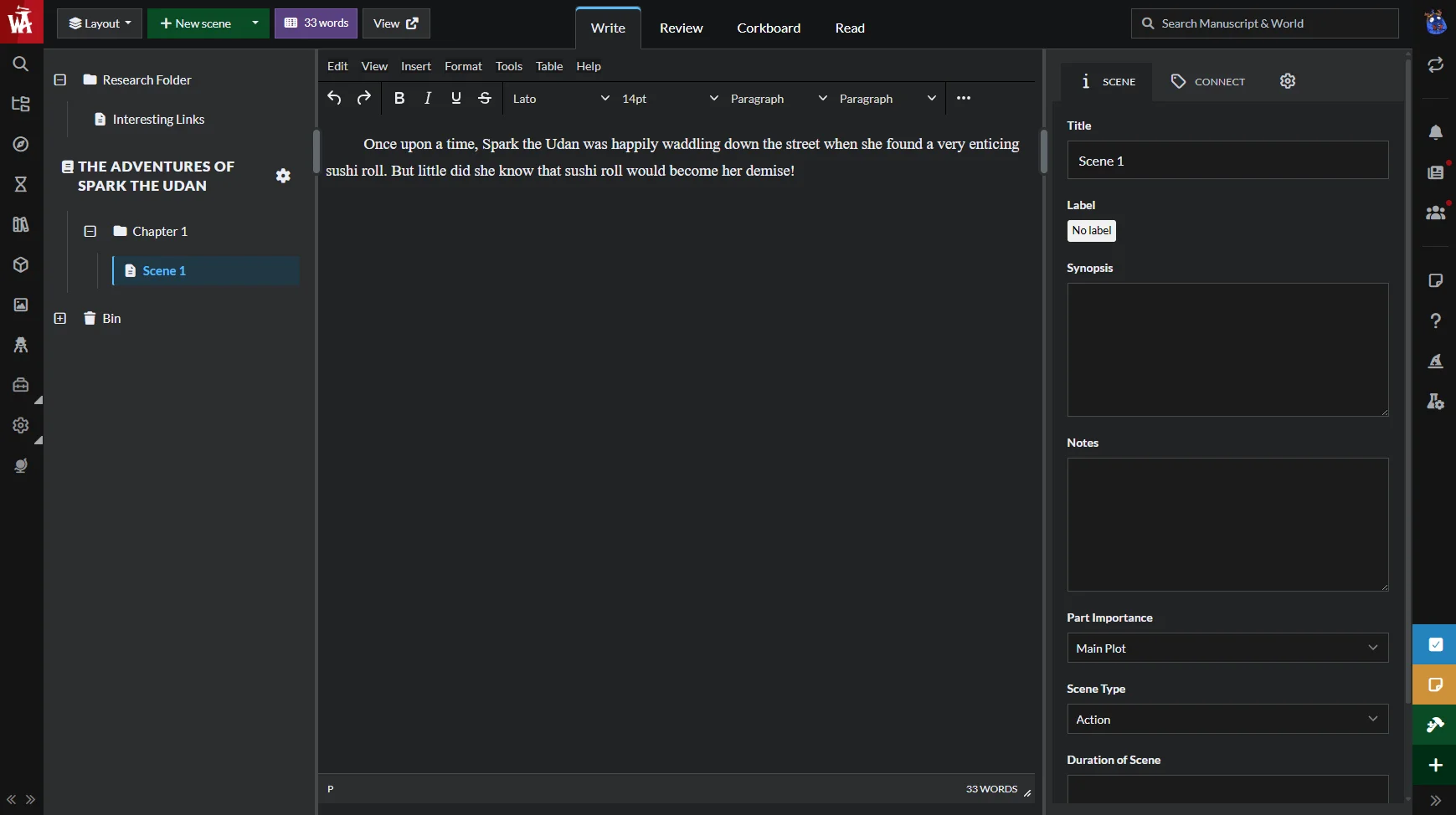
Writing beside your lore — World Anvil's Manuscripts splits the book into chapters and scenes, searches the manuscript and the world at once, and lets you open and edit an article without leaving the page. It starts on the Master plan.
In TypeTak, the manuscript and the World share one space from the start, and Split view keeps a character or an earlier chapter open beside the page. If you want, the agent can take on drafting and Revision, but you never have to use it.
Campfire's Manuscript module keeps your lore in a Notes sidebar and lets you tag characters and locations in the text. The desktop app works without an internet connection.
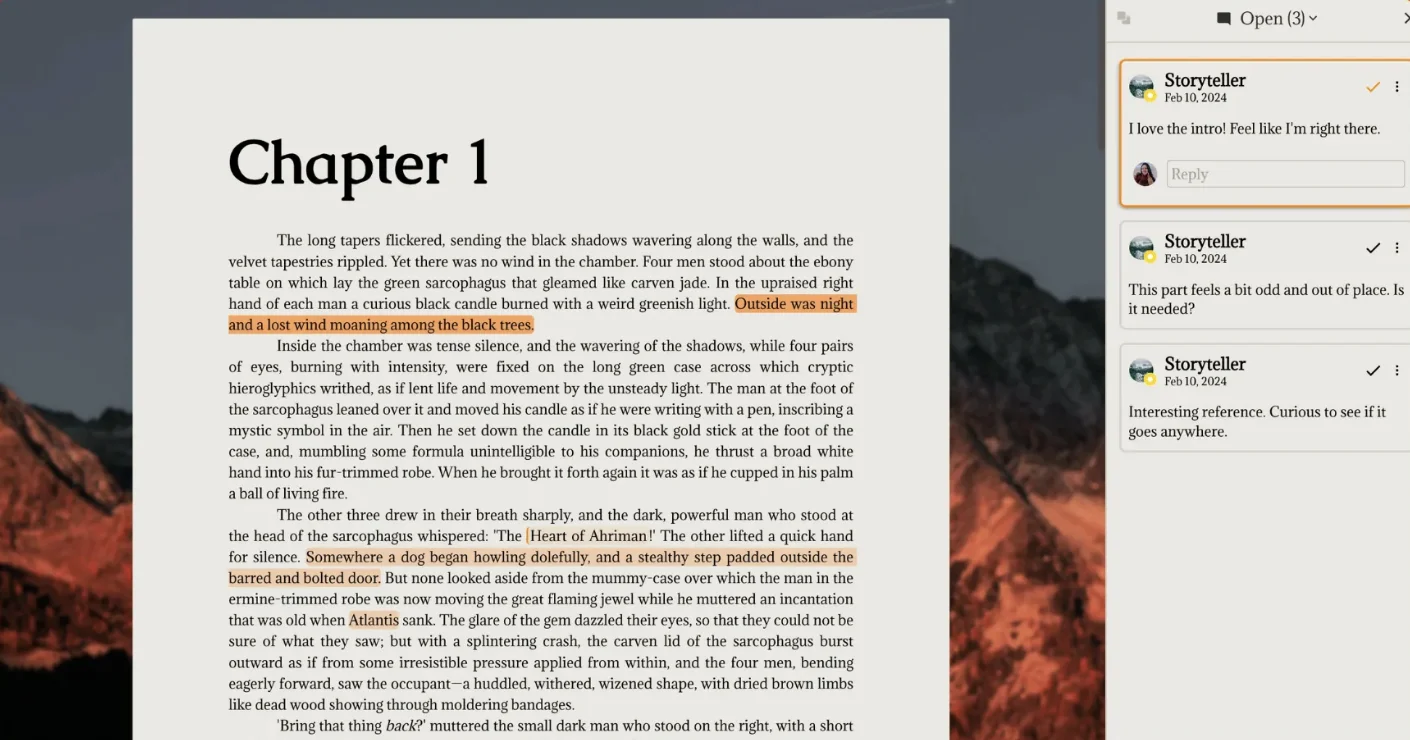
Chapters and word counts — All three lay chapters out as cards you drag to reorder. World Anvil adds a review mode for skimming chapter synopses and a daily word count, Campfire has chapter word goals, version history, and collaborator comments, and TypeTak switches the board to a table to skim the plot scene by scene.
Turning it into a book — When it's time to compile, check the export formats. TypeTak exports to PDF, DOCX, TXT, and EPUB, and Campfire to PDF and EPUB. World Anvil exports to HTML.
4. Publishing and sharing
| Feature | World Anvil | TypeTak | Campfire | LegendKeeper |
|---|---|---|---|---|
| Publish your world to the web | Pro plan | |||
| Control visibility entry by entry | Subscriber groups | Public · link · private | Share by element | Permissions |
| Customize the published design | Themes · CSS | Name · icon · cover | ||
| Visitors read the manuscript | Reading app · sales | |||
| Visitor comments | ||||
| Edit together | Co-authors | Invite collaborators | Real time | |
| Export your world | JSON · HTML | PDF · HTML · DOCX · TXT · Markdown | Backup · DOCX | HTML · JSON |
All four publish your world to the web and let you choose what to show to whom. Their personalities come through in how much you can style the public page, how you reach readers, and who you write with.
The public page — World Anvil gives you the most control over how your public world looks. Themes and CSS shape it, and subscriber groups let you open parts of articles, or even individual map pins, to different readers. In TypeTak, pick the manuscripts and World to publish and anyone can read them from one link, no login needed; visitors browse your lore as cards and a graph, read the manuscript like a book, and leave comments. LegendKeeper publishes with one click and uses permissions to decide what readers see.
Selling to readers — Campfire lets you sell your book in its own store and reading app, and you keep up to 80% of sales. Readers can unlock extras like character profiles and maps alongside the book.
Writing together — If you build with others, LegendKeeper makes it easiest. You edit together in real time and see each other's cursors on the map, and only the project owner needs the Pro plan; invited guests join free. Campfire also lets you invite as many collaborators as you like to view, comment, or edit. World Anvil supports co-authors, with one person editing an article at a time.
Pricing
| Item | World Anvil | TypeTak | Campfire | LegendKeeper |
|---|---|---|---|---|
| Monthly price | From $4.50/month billed yearly | $12 / $40 | $12 (all modules) | $9 |
| Ongoing free plan | ||||
| Free trial | 7 days | 14 days | ||
| Lifetime plan | Grandmaster · Sage | |||
| AI usage | Usage limit per plan |
Starting free — World Anvil, TypeTak, and Campfire all have free plans you can keep using. World Anvil's free plan (Freeman) allows 2 worlds, 2 maps with 10 pins, and 2 timelines; private worlds, Secrets, and Manuscripts need a paid plan. Campfire opens every module with caps, like 25,000 manuscript words and 10 characters. TypeTak's AI usage limit renews each cycle, and your World and manuscripts work on any plan if you don't use AI. You can pick the chat model (GPT · Gemini · Claude) on every plan, including Free; choosing a model per feature (Detailed models) is on the Max plan.
Paying — LegendKeeper needs the Pro plan after a 14-day trial; if your subscription lapses, you can still view and export your projects. If you'd rather pay once, World Anvil's top two plans (Grandmaster and Sage) and Campfire offer lifetime options, and Campfire also lets you buy only the modules you need.
World Anvil — Master, Grandmaster, Sage (from $4.50/month billed yearly, per the official FAQ). TypeTak — Pro $12/month ($9/month billed yearly), Max $40/month ($29/month billed yearly). Campfire — Standard $12/month. LegendKeeper — Pro $9/month or $90/year.
Which one fits you?
| What you want | World Anvil | TypeTak | Campfire | LegendKeeper |
|---|---|---|---|---|
| Build a world with nothing left out, guided by template prompts | 25+ templates | Define your own types | 18 modules | Start from a blank page |
| Style your world like a wiki and show it to readers | Themes · CSS | Cards · graph | Share by element | Name · icon · cover |
| Write lore and manuscript in one place | Master plan and up | One space | Manuscript module | |
| Build lore and drafts with AI | When you choose | |||
| Sell your book to readers | Store · reading app | |||
| Lay out your world around maps | Pins · layers | Pins · regions | Scale · nested maps | |
| Build together in real time | Co-authors | Invite collaborators | Real-time editing |
World Anvil fits writers who
- want template prompts to guide them through building a world with nothing left out
- want to show their world through maps, timelines, and family trees
- want to reveal lore to subscribers step by step
TypeTak fits writers who
- want their worldbuilding and manuscript in one place
- want to line up their lore in a relationship graph and a table
- want to publish their manuscript and world encyclopedia to readers together
- want to hand off lore organizing and drafting to AI when they choose
Campfire fits writers who
- want a dedicated module for each kind of lore, like magic systems, languages, and religions
- want to buy only the modules they need
- want to sell their book themselves, with extras
LegendKeeper fits writers who
- want to build their world around maps
- want to build a world together with others in real time
FAQ
Can I move my World Anvil lore to TypeTak?
Export your articles from World Anvil as HTML and upload them with TypeTak's Import, and they become document pages. Then ask the agent to organize them into your World, and it moves the characters, places, and lore into World entries.
Can I use TypeTak without AI?
Yes. You can create and edit every World entry and manuscript page yourself. Call on the agent only when you want it.
Is there a free World Anvil alternative?
TypeTak and Campfire both have free plans you can keep using. LegendKeeper requires a paid plan after its 14-day trial.
Sources
Share this post
Write a better opening line with TypeTak, starting today
Get started with TypeTak
Write a Web Novel, Step by Step
→Follow one web novel, They Say I'm a Dark Mage, but All I'm Good At Is Digging Dirt, from first idea to ready-to-serialize in TypeTak.